Posts

We All Know How This Ends

Image
Lance Corporal Schofield's message could save a thousand lives--but only if he can deliver it. "All my stories are true--and some of them actually happened." --Nikki Johnson "I've been to the movies, I've seen how it ends." --Brandi Carlile When the credits finally began to roll at the end of 1917 , I felt like I'd been in the theater for far more than the 117 minutes of the movie I'd just seen. I mean that in the best way. 1917  is a thriller that never lets up. Its quietest moments were nail-biting scenes of soldiers picking their way through No Man's Land, scouting abandoned barracks, and exploring a recently-vacated farm, during which there was always a sense of death lying just over the next hill, around the next corner, just one step deeper into the unknown. The concept is a well-used one: to avert a disastrous advance into a deadly trap, two young soldiers must hand-deliver a letter across miles of craters and barbed wire, d...
Thirty-Five Years Overdue

Image
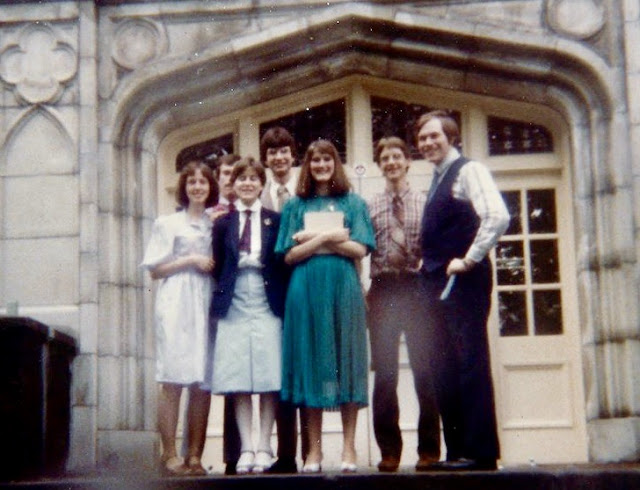
From left to right: Elizabeth, Rick, Annette, Scott G., Kathleen, Scott M., me; May 12, 1983, Lausanne Hall, Willamette University, Salem, Oregon I got the news November 18: Scott had died in July. The news gutted me. I found the obituary online, and the shock grew. There was no mention of the cause of death, which led me to believe it was health-related: heart disease, cancer, some other illness. What was most jarring to me was to learn what a full, rich life Scott had led--not that I'd expected any less of him, but that I was learning about it for the first time. I need to be clear here which Scott I'm talking about, as there were two. Scott Greenwood is still alive and well, and I have managed to speak with him a couple of times in this century. It's Scott Marchand who is gone. The two Scotts, plus Rick, and I all met on the first day of freshman orientation, August, 1979. There was another guy who was briefly in our group--I think his name was Chris--bu...

Words Fail Me

It's been awhile. My last post to this blog was in August. I was in professional limbo then, still interviewing for jobs, thinking I'd landed a couple of them, then learning that some other factor had altered my chances. Finally I found a principal willing to take a chance on me, but by now, I was counting on anything. I did get that job, very late in the summer, and I'm in it now. It's a challenging position, pushing me into areas I've never explored before. It's also forcing me to be more intentional than I've ever previously been about classroom management, and I think it's working. With as many disappointments as I've had over the years, I'm no longer willing to make predictions. My hope is that this will be the last job of my life, but check back with me in three years to see if I can finally call myself a contract, rather than probationary, teacher, counting down my last four years until retirement. Keeping abreast of this work has devo...

Preaching to You, Choir

Image
St. John of Patmos, the Dragon, and the Beast Hey choir! Yes, I'm talking to you: the faithful few who are here every Sunday, come heaven or high holy water, up there in the loft waiting for your special moments to shine. You're the glue that holds this congregation together. Your nods, smiles, scowls, "Amens" and "watch yourself, preacher" are the applause sign on this variety show. You've seen it all, heard it all, since long before I entered this pulpit, and you'll be here for whoever fills it once I'm gone, and the next one after that, on and on until this church is no longer here. As reliable a core constituency as you are, you're still human. Sometimes you shine, sometimes you fall hard on your face, most of the time you're just normal folk like anyone out there in the pews. You need the magnifying glass of scripture too, convicting you of your shortcomings; and you need the word of grace, releasing you from the burden of g...

There Is No Other Hand

Image
The subjects of Trump's latest assault on American values. There are so many ways to say "no" to this president. No, the four congresswomen you attacked are not going to be flown "home" by Nancy Pelosi to get them out of her hair. No, they're not foreigners, aliens, or even immigrants (even though one of them once was), they're citizens. No, the color of their skin does not make them any less American than invasive pink-skinned you. No, the act of criticizing this country is not unpatriotic (in fact, you did plenty of it during your own campaign). No, no, no, no, no. Since Donald Trump began his campaign with an attack on Mexican-Americans, "no" has been the prevailing message of every thoughtful pundit, regardless of political persuasion. No to the misogyny, the lying, the sabre-rattling, the racism, the rabble-rousing, the bluster, the threats, the incompetence, the corruption, the grifting and graft, the assaults on anything and eve...

And Beyond

Image
Woody, Buzz, Jessie, and Forky Warning: here there be spoilers aplenty. Sequels have been around as long as storytelling. The best storytelling is incomplete. It creates outlines of engaging characters, but lets the audience use their experience and imagination to fill them out. It does the same with the universe in which it places these characters, as well as with the plot that carries them from beginning to end. To do this well, the storyteller must trust the audience, and have confidence in their intelligence and creativity. The best-told stories leave audiences both satisfied and hungry, wanting to revisit the universe, spend more time with the characters, see it from different angles. But the best stories are so complete that sequels are unnecessary: the work stands on its own. To justify its existence, a sequel must present something so new, no distinctive, that it is a good story in its own right. Such was the case with the most ancient story/sequel pairing I ...

Democracy on the Rocks

Image
Entrusting the governance of a nation to democracy is like turning a horse loose in a hospital: the best result that can be hoped for is that no one was severely injured. Reading the Constitution, it's easy to see just how skeptical the founders were of this system they'd chosen for the fledgling United States of America. They were in agreement of the principle that power should reside in the people, but they were unsure how to channel that power into governing authorities. Looking back on history, they could see that classical experiments in democracy had been limited to city states, and none of them had lasted long. For democratic government on a national scale, they had only Britain to compare themselves to, and that system's reliance on a hereditary monarchy was the very thing they had rebelled against. They'd also had several years to experiment with a weak central government, and the results had been so chaotic as to mandate a major revision of the ne...