Posts

Showing posts with the label itineracy

Thirty-Five Years Overdue
Image
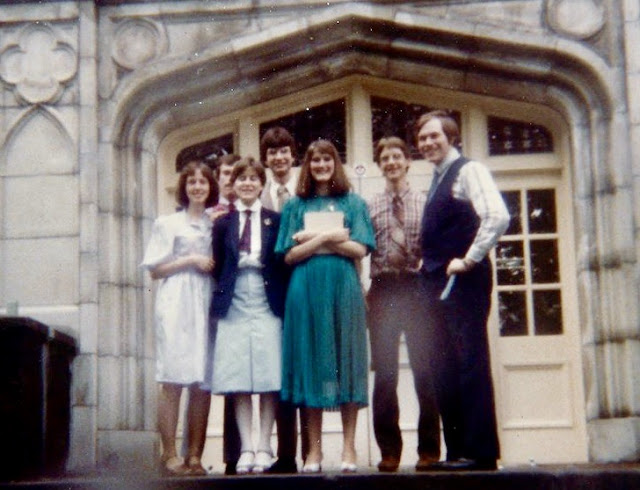
From left to right: Elizabeth, Rick, Annette, Scott G., Kathleen, Scott M., me; May 12, 1983, Lausanne Hall, Willamette University, Salem, Oregon I got the news November 18: Scott had died in July. The news gutted me. I found the obituary online, and the shock grew. There was no mention of the cause of death, which led me to believe it was health-related: heart disease, cancer, some other illness. What was most jarring to me was to learn what a full, rich life Scott had led--not that I'd expected any less of him, but that I was learning about it for the first time. I need to be clear here which Scott I'm talking about, as there were two. Scott Greenwood is still alive and well, and I have managed to speak with him a couple of times in this century. It's Scott Marchand who is gone. The two Scotts, plus Rick, and I all met on the first day of freshman orientation, August, 1979. There was another guy who was briefly in our group--I think his name was Chris--bu...

Here to Stay

Image
It begins: toasting our first house together, June 26, 2012. I've just entered undiscovered country. On the day I was born in San Jose, California, I was already getting ready to move: my father, then an American Baptist minister, was candidating for a new position up the coast in Fort Bragg. Five weeks later, we moved there, and the die was cast: for the next fifty-five years, the longest I would keep an address would be the four years I was in high school. I can't pin it all on my father's profession (although switching to Methodist, as he did in 1964, locked him into their peculiar practice of itinerant ministry); from college until Amy and I moved into our current home, the longest I kept an address was three years. Note the word "until" in the last sentence, because as of today, I've set a new personal record. We moved into this house four years and a day ago. For the first two years, we were renters, but then our property manager infor...

Located

Image
Three years and two months. That's how long I've lived at 6420 NW Starflower Drive. That's a long time for me to have an address. In fact, it's a record for me: my previous record for holding one address as an adult was two years and ten months. You may be thinking that's a horribly itinerant way to live. The saving grace, you may also be thinking, is that the word "adult" in that paragraph means I had a more stable childhood. And you'd be right for thinking that--but not a lot. The longest I lived anywhere before college was four years. When I tell people this, their first response is typically "Army brat?" "Preacher's kid" is my reply. And that does explain all that moving around in my childhood, an average of every three years: my father was an American Baptist, and then a United Methodist, pastor. As an American Baptist, his job was subject to the whims of his church council and the personalities that ran it. After...

Moving In

Image
I have always been itinerant. I moved for the first time when I was five weeks old. My father's career as a minister, first in the American Baptist Church, then the United Methodist Church, meant we moved on average every three years. Once I finished my schooling at the age of 30, I kept moving. The longest I've had a single address was the four years I lived in Philomath--my high school years. It appears the moving has, finally, slowed down: our plan is to remain in this house another four and a half years, then move to somewhere in inner Portland, where we may expect to spend the rest of our independent adult lives. That was my parents' story, too: my father's longest appointment was his last, and since retiring in 1990, he and my mother have lived continuously in the house they inherited from my grandmother. I've changed jobs a lot, too, and not just in my ministry years. I was technically in the Banks district for six years, but the middle two were on layo...

Bliss Point

Image
Did I mention I like Star Trek ? Welcome to Sisko's Creole Kitchen, an establishment that epitomizes the economics of the 24th century, when technological innovations work hand-in-hand with fully enlightened attitudes toward work and leisure to liberate human beings from wage slavery. People are no longer locked into drudgery by the need to earn a living wage, for all essential human needs are provided by society. Money is a dim memory, as anything one wants or needs can be instantly replicated. Individuals are freed up to follow their true vocations, whether that means enlisting in Star Fleet to explore the galaxy or opening a five-star restaurant in New Orleans. This doesn't mean that anyone can just do exactly what he or she wants. Joseph Sisko, I assume, prefers serving authentic dishes made from scratch, rather than replicated to identical perfection, which means someone still has to catch the crabs for his kitchen, and someone else has to cook it. I expect there...

Born Under a Wandering Star

Image
I was born under a wandrin' star I was born under a wandrin' star Wheels are made for rolling, mules are made to pack I've never seen a sight that didn't look better looking back I was born under a wandrin' star Mud can make you prisoner and the plains can bake you dry Snow can burn your eyes, but only people make you cry Home is made for coming from, for dreams of going to Which with any luck will never come true I was born under a wandrin' star I was born under a wandrin' star Do I know where hell is, hell is in hello Heaven is goodbye forever, its time for me to go I was born under a wandrin' star A wandrin' wandrin' star When I get to heaven, tie me to a tree For I'll begin to roam and soon you'll know where I will be I was born under a wandrin' star A wandrin' wandrin' star (from Paint Your Wagon , Lerner & Loewe, 1951) When people ask me what my home town is, I am at a loss. I tell them I've moved around a l...

Methodist Dogmatics

Image
  Methodism is a non-credal denomination.   Ostensibly that means Methodists do not have a statement of faith to which they must adhere in order to belong to the church. That should mean there is no such thing in Methodism as heresy, as to be a heretic is to act contrary to the dogma of the church. And in traditional terms, Methodists remain non-dogmatic. While Methodists are expected to believe in the Trinity, the Resurrection, and other doctrines typical of Christians throughout the world, there is no one way in which they must believe. Methodists can believe, for instance, that Jesus was a great teacher and historical figure, but that the miracles presented in the Gospels are symbolic, that the Resurrection describes something that happened in the disciples' hearts, that, in fact, all the teachings about the divinity of Christ are metaphors for how humans can find spiritual fulfillment through prayer and good works, and still be fully within the fold of the church....